As we get older, maintaining muscle is important. But when it comes to preventing falls, simply having muscle may not be enough. We also need the ability to use that muscle quickly.
That is where Type II muscle fibers become especially important.
Type II fibers are often called fast-twitch muscle fibers. They are designed to produce force rapidly. They help us jump, sprint, lift something heavy, climb stairs, rise from a chair—and perhaps most importantly for an older adult, react quickly when we lose our balance.
Think about what happens when you trip over a curb. You don’t have several seconds to think about what to do. Your body has a fraction of a second to respond. A leg needs to shoot forward. Your foot has to hit the ground. Your hip and trunk muscles have to stabilize you. Your arms may move instinctively to help restore balance. That rapid response depends partly on muscular power and the nervous system’s ability to recruit muscle quickly.
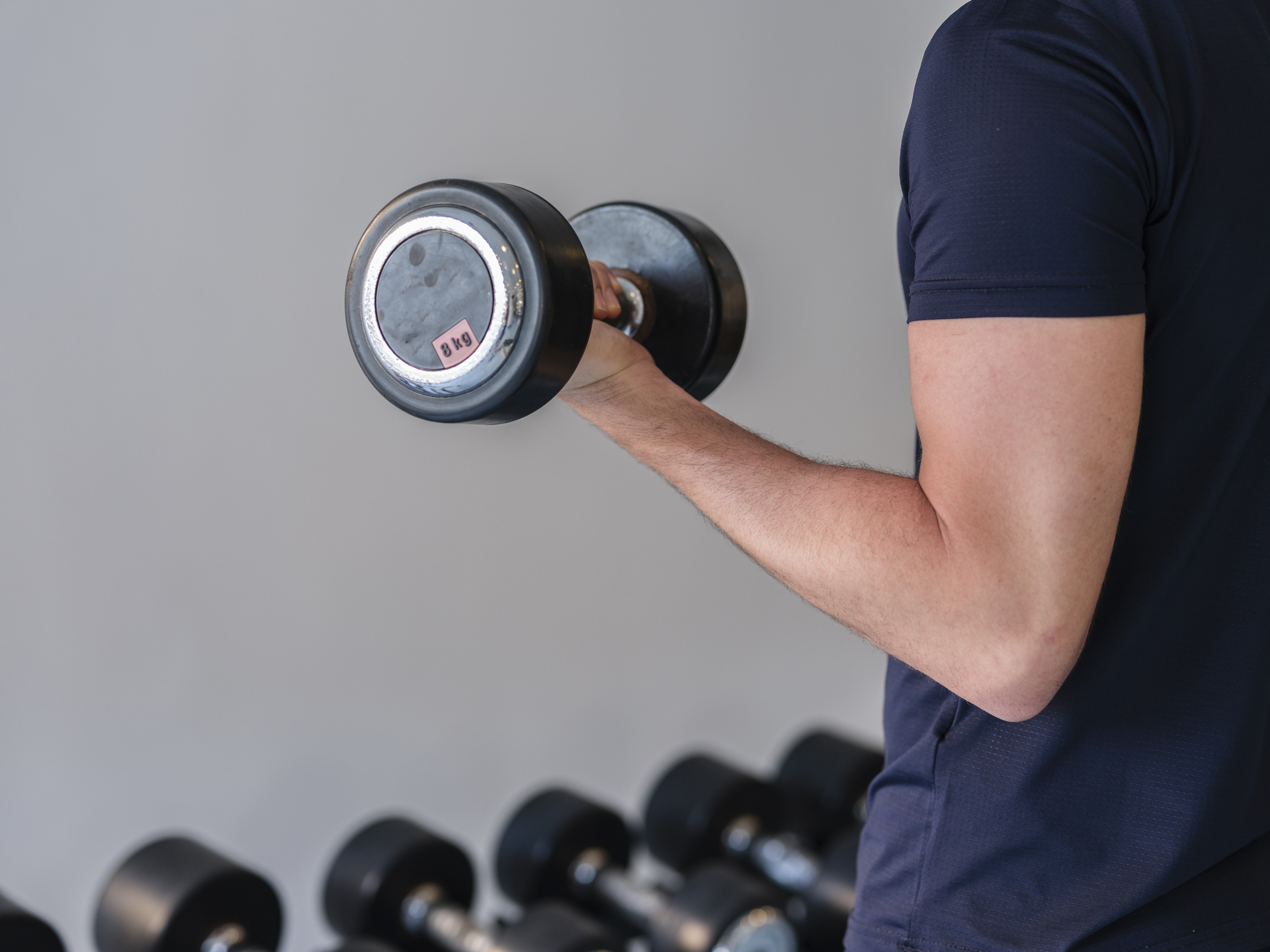
This is one reason I believe strength training—particularly appropriately programmed heavier resistance training—deserves an important place in fitness programs for older adults.
Type I vs. Type II Muscle Fibers
Our skeletal muscles contain different types of muscle fibers.
Type I fibers, commonly called slow-twitch fibers, are highly fatigue-resistant. They are important for endurance activities such as walking, maintaining posture and performing activities for extended periods.
Type II fibers are capable of developing force more rapidly. They play a major role when the body needs strength, speed and power.
Both are important.
The problem is that aging tends to have a particularly significant effect on the neuromuscular system responsible for fast, powerful movement. We can lose muscle mass, strength and especially power as we grow older. If we don’t challenge these abilities, getting out of a chair becomes harder, climbing stairs becomes more difficult, and our ability to recover from a loss of balance may decline. That last point is extremely important.
A Fall Happens Fast
Imagine walking across a parking lot and catching your toe on an uneven section of pavement.
Your center of gravity suddenly moves outside your base of support.
Now your body has a decision to make.
Can you produce enough force, quickly enough, to take a recovery step? That ability is different from simply being able to stand on one leg for 30 seconds.
Static balance exercises certainly have value, but real-world falls are often dynamic. We trip. We slip. We misjudge a step. Someone bumps into us. A dog pulls unexpectedly on a leash.
Your body must react.
This is why I like to think of fast-twitch muscle fibers as part of the body’s emergency response system. You hope you don’t need that emergency system—but when you do, you want it available.
Why Heavier Resistance Can Matter
Many older adults have been told that they should only lift light weights. There is certainly a place for lighter resistance, particularly when someone is beginning an exercise program, recovering from an injury or working around a medical or orthopedic condition. But age alone does not automatically mean that resistance training must always be light.
Progressively heavier resistance can provide a powerful stimulus for maintaining and improving strength. As resistance increases, the nervous system must recruit additional motor units to meet the demand. This includes the higher-threshold motor units associated with Type II fibers. In practical terms, appropriately challenging resistance tells the body:
I still need this strength. Don’t get rid of it.
Exercises such as squats or sit-to-stands, leg presses, rows, presses, hip hinges and step-ups can be progressively loaded according to the person’s ability.
“Heavier” is also relative.
A heavy weight for a 75-year-old beginner may be very different from a heavy weight for a lifelong 75-year-old lifter. The objective isn’t to chase a number on a barbell. The objective is to provide enough resistance to challenge the muscles while maintaining good technique and an appropriate margin of safety.
Strength Is Important—But Power May Be Even More Relevant to a Trip
Strength and power are related, but they aren’t identical. Strength refers to how much force you can produce. Power involves producing force quickly.
Suppose two people can both stand up from a chair without using their hands. One can rise rapidly and under control. The other requires several seconds. Both completed the movement, but their ability to generate force quickly is very different. That difference may matter when balance is suddenly disturbed. This is why an older-adult training program can eventually incorporate carefully selected movements in which the intention is to move quickly during the lifting portion while remaining controlled. That doesn’t mean performing reckless or explosive exercises.
Something as simple as a sit-to-stand performed with the instruction “stand up quickly, sit down under control” begins introducing the concept of power.
A step-up can be performed with a purposeful upward drive.
A resistance-band row can have a faster pulling phase followed by a controlled return.
The goal is not speed for its own sake. It is teaching the neuromuscular system to produce usable force rapidly.
Strong Legs Create a Better Foundation
Balance isn’t controlled by one muscle. The ankles, calves, quadriceps, hamstrings, glutes, hips and trunk all contribute to keeping us upright and recovering from disturbances.
Consider the importance of the hips. If you begin falling sideways, the hip muscles may need to generate force quickly to reposition your body or allow you to take a lateral step.
If you stumble forward, the muscles of the legs and hips must rapidly help create a recovery step and control your body weight.
This is why strengthening the lower body is about much more than appearance.
We’re building physical reserve. When everyday life suddenly demands more strength than usual, that reserve may become extremely valuable.
Balance Training and Strength Training Belong Together
Heavy resistance training should not be viewed as a replacement for balance training. The best approach is to develop multiple physical qualities. For an older adult, that may include progressive resistance training, balance exercises, gait training, stepping drills, appropriate power training and aerobic conditioning. We want to improve not only the muscles but the entire neuromuscular system. For example, standing on one leg can challenge balance. But practicing rapid stepping in different directions can train a different skill: recovering balance once it has already been disturbed.
Combine that ability with stronger legs and better power, and you begin developing a much more complete fall-prevention strategy.
You Don’t Have to Train Like a Powerlifter
When I encourage older adults to lift heavier weights, I’m not suggesting that everyone should perform maximal lifts. The goal is progressive overload.Begin with a resistance you can control with excellent technique. As you become stronger, gradually increase the challenge.
Depending on the individual, that progression might involve adding resistance, performing a more difficult variation, increasing range of motion or eventually introducing controlled faster movements. Medical history, joint health, medications, previous injuries and experience should always be considered. People with cardiovascular disease, osteoporosis, significant arthritis, balance disorders or other medical concerns may need guidance from their healthcare professional and an appropriately qualified fitness professional.
The objective isn’t proving how much weight you can lift. The objective is maintaining the physical capabilities required for life.
Train Today for the Unexpected Moment Tomorrow
Most of us don’t think about fall prevention until balance begins to deteriorate.
I believe we should think about it much earlier.
Train your legs.
Strengthen your hips.
Challenge your balance.
Practice stepping.
Maintain your cardiovascular fitness.
And don’t forget about power.
Because someday the most important repetition you perform won’t happen in the gym.
It may happen when your foot catches the edge of a sidewalk.
You stumble.
Your body reacts.
Your leg shoots forward.
Your muscles produce force quickly enough to get your foot underneath you.
And instead of falling, you catch yourself.
That’s why maintaining Type II muscle fibers and the ability to generate force quickly isn’t just about athletic performance.
For older adults, it can be about something far more important:
maintaining balance, confidence, independence and the ability to keep doing the things we love.
Jim Burns, NASM-CPT, Senior Fitness Specialist, Corrective Exercise Specialist & Behavior Change Specialist
Be Simply Fit