
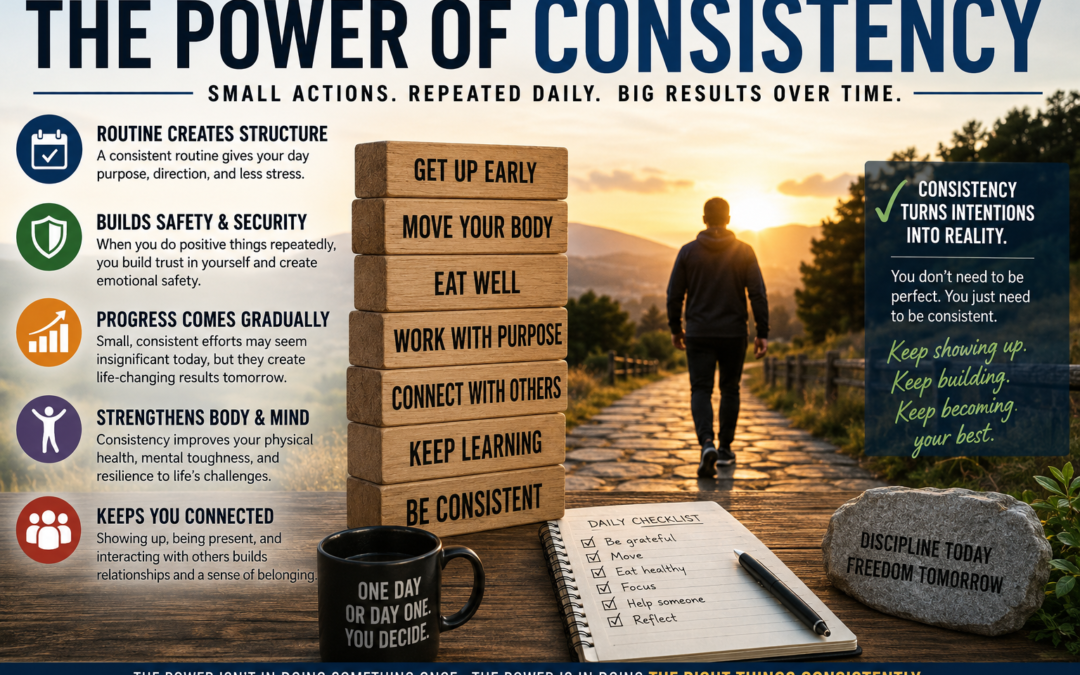
There is something incredibly powerful about doing the ordinary things in life over and over again. Get up. Make the bed. Take a shower. Get dressed. Have breakfast. Leave the house. Stop for a cup of coffee. Drive to work. Say good morning to the people you see every day. Do your job. Have conversations. Solve problems. Come home. Exercise. Eat dinner. Get ready for tomorrow. Go to bed. None of these things sound particularly exciting. Yet, taken together, they provide something that human beings desperately need: structure, predictability, purpose, safety, and security.
I believe consistency is one of the foundations of emotional fitness.
In my book Be Simply Fit Emotionally, I describe emotional fitness as more than simply feeling happy. It includes optimism, self-esteem, self-acceptance, fulfillment, healthy relationships, and the ability to experience and express normal human emotions. Routine can help support many of those qualities because it gives our lives a framework.
Routine Gives the Day a Purpose
There is value in getting up early. Getting up early isn’t magical because of the number on the clock. The benefit comes from beginning the day intentionally rather than allowing the day to happen to you. Think about the traditional workday routine. Your alarm goes off. You get out of bed even though you might prefer another hour of sleep. You shower, shave, get dressed, and prepare yourself for the day.
Maybe you stop at the same coffee shop every morning. Someone behind the counter recognizes you.
“Good morning.”
“How are you?”
You drive to work. You walk through the door and see your colleagues. You talk about what happened yesterday. Someone asks about your family. Someone needs your help. Someone tells a joke. You attend a meeting. You disagree with somebody. You solve a problem together.
These interactions might seem insignificant, but they aren’t.
They are part of being connected to the world.
They require us to communicate, cooperate, compromise, listen, respond appropriately, and sometimes tolerate a little frustration. These ordinary interactions help keep us socially and emotionally conditioned.
In Be Simply Fit Emotionally, I discuss qualities such as respect, responsibility, patience, self-control, gratitude, initiative, and maturity. Daily life gives us opportunities to practice those qualities.
COVID Changed More Than Where We Worked
The COVID-19 pandemic disrupted many of the routines that people had followed for decades.
Suddenly, millions of people didn’t have to get up and commute to work. The bedroom became the office. Meetings became video calls. Coffee with colleagues disappeared. Lunch conversations disappeared. The separation between work and home became blurred.
Remote work certainly has advantages, and for many people it continues to be productive and practical. The problem isn’t necessarily working from home. The problem occurs when convenience gradually eliminates too many of the routines, interactions, and small challenges that once required us to engage with the outside world.
Human beings can become accustomed to convenience remarkably quickly.
Once we become accustomed to avoiding discomfort, almost anything requiring effort can begin to feel unnecessarily difficult.
Why drive somewhere when I can have it delivered?
Why go to the store when I can order it online?
Why meet someone when I can text them?
Why go to the gym when staying on the couch is easier?
Why have difficult conversations when I can avoid the certain people?
Why get dressed when I don’t have to leave the house?
Individually, none of these decisions is necessarily harmful. But collectively, they can create a lifestyle where comfort becomes the goal and discomfort becomes something to fear.
That concerns me.
We Need Some Discomfort
Exercise provides a perfect example.Your muscles don’t become stronger because you make everything easy for them. They become stronger because you gradually ask them to handle resistance.
Your cardiovascular system improves when you challenge it appropriately.
Your balance improves when you practice balance.
Your mobility improves when you move.
I believe something similar happens emotionally.
We need appropriate amounts of social, mental, and emotional resistance.
Sometimes you need to get out of bed when you don’t feel like it.
Sometimes you need to go to work when you’d rather stay home.
Sometimes you need to exercise when you’d rather sit down.
Sometimes you need to talk to someone when you’d rather avoid the conversation.
Sometimes you need to cooperate with someone you disagree with.
Sometimes you need to hear criticism.
Sometimes you need to be uncomfortable.
That doesn’t mean we should seek misery. It means we shouldn’t automatically interpret discomfort as something harmful.
Discomfort is often where growth begins.
Repetition Creates Safety and Security
One of my strongest beliefs is that doing positive things repeatedly creates a sense of safety and security. Think about children. Children generally thrive when they know what is going to happen next. Bedtime routines, family meals, school schedules, sports practices, chores, and family traditions provide predictability.
Adults aren’t that different. When you have a routine, you don’t have to renegotiate your entire life every morning.
You know when you wake up.
You know when you work.
You know when you exercise.
You know when you eat.
You know when you relax.
You know when you go to bed.
That predictability reduces the number of decisions you have to make and creates a rhythm to your life.
Most importantly, consistency begins building trust in yourself.
You said you were going to walk today, and you walked.
You said you were going to exercise three times this week, and you did.
You said you would get up at 6:00, and you got up.
Every time you keep one of these small promises to yourself, you are providing evidence that you can depend on yourself.
That is a powerful form of security.
Consistency Makes Exercise Easier
People often tell me they don’t feel motivated to exercise.
I believe waiting for motivation is one of the biggest mistakes people make. If a person is waiting to be motivated they probably don’t want to exercise. Motivation is based on a feeling. If they are waiting to feel like it that feeling may never come.
Don’t wait until you feel like exercising.
Create a routine.
If Monday, Wednesday, and Friday at 8:00 are your exercise days, eventually you stop asking yourself whether you feel like working out. You simply know what happens at 8:00.
Consistency transforms exercise from a decision into a habit.
The same principle applies to walking, stretching, eating well, sleeping, maintaining relationships, and almost every other healthy behavior.
You don’t need perfection.
You need repetition.
Consistency Keeps Us Connected
Routine also helps prevent isolation.
When we leave our homes, we encounter people.
The person pouring your coffee matters.
The coworker you talk to matters.
The neighbor you wave to matters.
The person at the gym matters.
These seemingly insignificant interactions remind us that we belong to something larger than ourselves.
In Be Simply Fit Emotionally, I discuss the importance of spending time with loved ones, giving others attention, being respectful, cooperating even when we disagree, and maintaining relationships. Those skills don’t develop in isolation. We practice them by being around people.
The less we interact, the easier it becomes to avoid interaction.
The less we move, the easier it becomes to remain sedentary.
The less discomfort we tolerate, the more uncomfortable ordinary challenges can begin to feel.
That cycle needs to be broken through action.
Get Up and Participate in Your Life
Sometimes the answer is surprisingly simple.
Set the alarm.
Get up.
Make your bed.
Take a shower.
Get dressed.
Leave the house.
Grab a cup of coffee.
Talk to somebody.
Go to work.
Exercise.
Call a friend.
Help someone.
Do something productive.
Then get up tomorrow and do it again.
And again.
And again.
There will be days when you don’t feel like doing it. Those may be the days when the routine matters most.
Consistency doesn’t mean that every day will be wonderful. It means that you have developed a structure that can help carry you through the days that aren’t.
Physical fitness isn’t created by one workout. Emotional fitness isn’t created by one good day. Strong relationships aren’t created by one conversation. A meaningful life isn’t created by one grand decision.
They are created through thousands of seemingly insignificant decisions repeated over time.
Routine creates familiarity. Familiarity creates confidence. Confidence creates security. And security gives us the courage to tolerate discomfort, interact with others, exercise, work, grow, and participate fully in life.
The power isn’t in doing something once.
The power is in doing the right things consistently.