
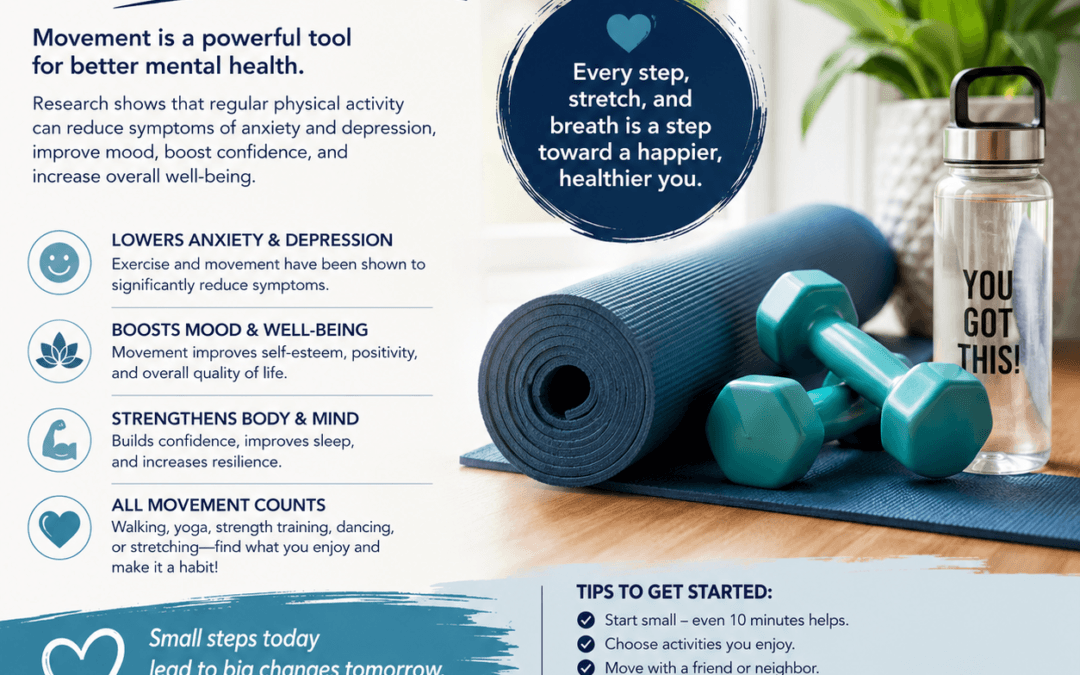
Movement is one of the most powerful yet underutilized tools for improving mental health. While counseling, medication, and other therapeutic approaches remain important treatments for anxiety and depression, research consistently demonstrates that physical activity can play a significant role in enhancing emotional well-being. The relationship between movement and mental health is reciprocal: movement improves mental health, and improved mental health increases a person’s desire and ability to continue moving. This creates a positive cycle that can dramatically improve quality of life.
For many years, mental health treatment focused primarily on psychotherapy and medication. However, research dating back to 1988 revealed a strong relationship between regular physical activity and positive mental health. Individuals who engage in consistent movement report better moods, greater overall well-being, and fewer symptoms of anxiety and depression. Exercise should not be viewed as a replacement for professional mental health treatment when it is needed, but rather as an essential component of a comprehensive wellness strategy.
One of the most well-documented benefits of movement is its ability to reduce anxiety. A review of 49 research studies found that individuals who exercised experienced greater reductions in anxiety than those receiving many other forms of anxiety-reduction treatment. Remarkably, these improvements were observed across men and women of all ages and fitness levels, including individuals diagnosed with anxiety disorders. Even more encouraging is that anxiety decreased regardless of the type, duration, or intensity of exercise performed. This suggests that simply moving the body consistently is more important than finding the “perfect” exercise program.
Additional research has shown that exercise is particularly beneficial for individuals with heightened anxiety sensitivity. In one study, participants who completed only two weeks of exercise experienced significant reductions in anxiety compared with a control group. Interestingly, combining exercise with cognitive restructuring did not produce greater improvements than exercise alone. These findings highlight the tremendous therapeutic power of physical activity. Researchers also caution that exercise does not directly eliminate anxiety; rather, it improves mood, which subsequently reduces anxious feelings. In other words, movement changes how we feel emotionally, allowing us to respond to life’s challenges with greater resilience.
Exercise is equally valuable in combating depression. Large meta-analyses have concluded that moderate-intensity exercise is an evidence-based treatment for both depression and major depressive disorder. Activities such as brisk walking, cycling, swimming, or strength training performed at moderate intensity can significantly reduce depressive symptoms. Yoga also deserves special attention. Research has demonstrated that consistent yoga practice not only reduces symptoms of depression but also increases levels of gamma-aminobutyric acid (GABA), a neurotransmitter associated with relaxation and emotional stability. Deep breathing exercises, a central component of yoga, further contribute to improved mood and reduced anxiety.
Beyond its physiological effects, yoga offers several psychological advantages. It improves posture, balance, strength, flexibility, and breathing while encouraging mindfulness and body awareness. Unlike many forms of exercise that emphasize external performance, yoga teaches individuals to turn inward, connecting their body, mind, and breath. Because yoga can be modified for nearly every fitness level, it provides an accessible option for individuals whose depression or anxiety has reduced their energy or motivation to exercise.
The benefits of movement extend well beyond reducing anxiety and depression. Regular exercise improves self-acceptance, personal growth, positive relationships, autonomy, and purpose in life—all important components of psychological well-being. Exercise also enhances self-efficacy, or a person’s belief in their ability to succeed. As individuals experience success through consistent movement, they gain confidence that often transfers into other areas of life. Additional benefits include improved sleep quality, enhanced brain function, and reduced stress levels. Physically active individuals also tend to demonstrate greater resilience, more positive attitudes, and better coping skills during difficult situations.
An important question often asked is whether one form of exercise is superior to another. Research suggests that the answer is no. Aerobic exercise, circuit training, Tai Chi, strength training, and flexibility exercises all appear capable of reducing anxiety and improving mood. Studies comparing these different exercise modalities found similar emotional benefits across all forms of movement. This is encouraging because it allows individuals to choose activities they genuinely enjoy, increasing the likelihood that they will remain consistent over time.
Although nearly all movement is beneficial, exercise intensity matters. Moderate-intensity resistance training appears to produce the greatest improvements in mood and reductions in anxiety. Very high-intensity exercise, particularly for beginners, may actually produce negative emotional responses. Research suggests that exercise programs should maximize enjoyment while minimizing unnecessary discomfort, especially for novice exercisers. Furthermore, while anxiety may decrease immediately following a workout, these benefits often diminish within 24 hours if movement is not repeated. Consequently, consistency—not intensity—is the true key to long-term mental health improvements. Regular exercise performed over weeks and months produces far greater psychological benefits than occasional workouts.
In conclusion, movement represents one of the most accessible and effective strategies for enhancing mental health. Whether through walking, resistance training, yoga, Tai Chi, or another enjoyable activity, regular movement improves mood, reduces anxiety and depression, enhances confidence, and strengthens an individual’s ability to cope with life’s challenges. The greatest benefit comes not from finding the perfect workout, but from developing a sustainable habit of moving consistently. When movement becomes a regular part of daily life, it nurtures both the body and the mind, creating a foundation for lifelong emotional health and well-being.