One of the greatest obstacles to lifelong fitness isn’t an injury, arthritis, a bad back, or even a chronic health condition. It’s the belief that because you can’t do what you used to do, you shouldn’t do anything at all. Nothing could be further from the truth. As a personal trainer, I have worked with people recovering from joint replacements, heart surgery, tendon injuries, arthritis, back pain, osteoporosis, and countless other physical challenges. The clients who make the greatest progress all share one common characteristic—they stop focusing on what they have lost and begin focusing on what they still have.
That change in mindset changes everything.
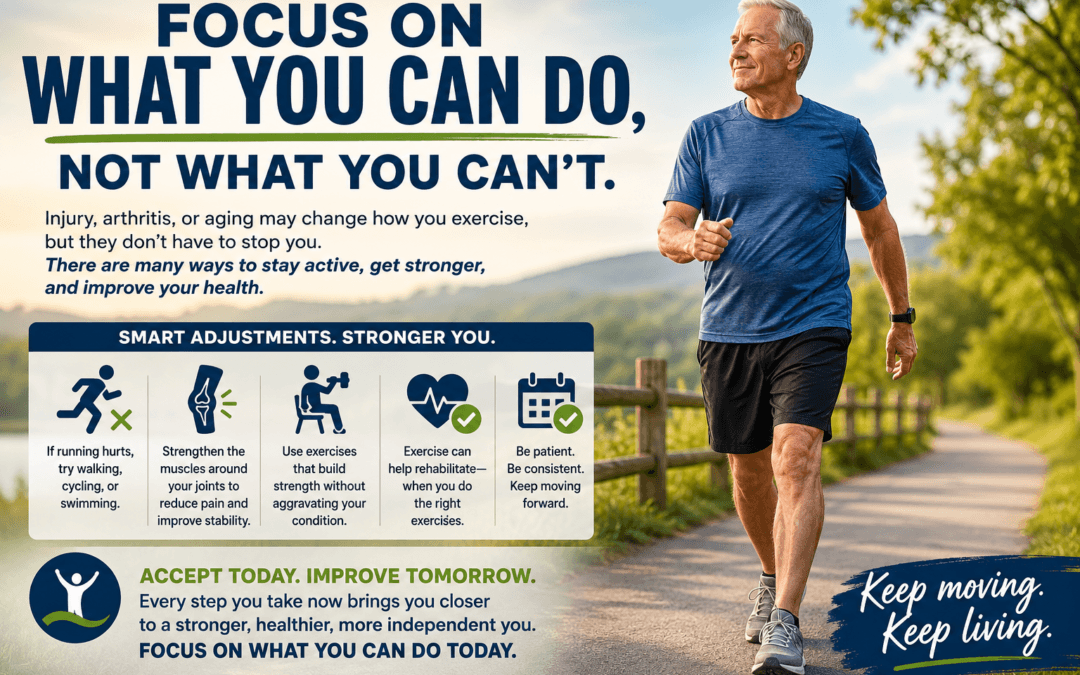
Our bodies are incredibly adaptable. When one movement becomes painful, there is almost always another way to train the same muscles, improve cardiovascular fitness, or maintain strength without making the condition worse. The goal isn’t to prove how tough you are. The goal is to become healthier while respecting your body’s current limitations. Many people make the mistake of trying to exercise exactly as they did before an injury. That approach often leads to frustration, setbacks, and sometimes an even more serious injury. Instead, exercise should become part of the rehabilitation process.
The right exercise heals.
The wrong exercise aggravates.
Knowing the difference is critical.
Take running as an example. Imagine you’ve been a runner for years, but you begin developing pain in your hips, knees, or feet. Muscle weakness develops around the hips, your gait changes, and every run becomes more uncomfortable. Many runners stubbornly continue because they don’t want to “lose their fitness.” Ironically, continuing to run may be exactly what causes them to lose it.
A better strategy may be to temporarily replace running with brisk walking, cycling, swimming, or using an elliptical trainer while strengthening the muscles that are causing the problem. Weak hip stabilizers, poor ankle mobility, tight calves, or weak feet can all contribute to inefficient movement patterns. By correcting these weaknesses first, many people can eventually return to running stronger than before.
Walking isn’t giving up.
It’s being smart.
The same principle applies to nearly every injury or degenerative condition. If arthritis makes heavy squats painful, there may be partial squats, chair squats, step-ups, resistance bands, or leg presses that accomplish the same objective without irritating the joint. If shoulder pain prevents overhead pressing, rows, resistance band exercises, or carefully selected pressing angles may allow you to strengthen the shoulder safely while it heals. If back pain makes certain exercises impossible, improving core stability, posture, hip mobility, and glute strength may actually reduce the pain over time.
Exercise is medicine—but only when the prescription is correct.
One of the biggest mental challenges people face is comparing themselves to who they used to be. They remember lifting heavier weights, running faster miles, or playing sports without discomfort. While those memories can be motivating, they can also become discouraging if they’re all you focus on. Instead, ask yourself a different question:
“What can I do today that moves me one step closer to better health?”
Maybe today it’s a 20-minute walk.
Maybe it’s stretching.
Maybe it’s balance training.
Maybe it’s exercising in a pool.
Maybe it’s simply getting out of the chair every hour and moving.
Every one of those choices is a victory.
As we age, fitness becomes less about athletic performance and more about maintaining independence. We exercise so we can climb stairs, carry groceries, play with grandchildren, travel, garden, golf, hike, or simply get up from the floor without assistance. Your exercise program should support the life you want to live—not aggravate the condition you’re trying to overcome.
There is tremendous wisdom in accepting where your body is today while continuing to work toward where it can be tomorrow. Acceptance is not surrender. Acceptance simply means acknowledging today’s reality so you can make tomorrow better. I’ve often told my clients that there are hundreds of ways to exercise. If one door closes because of an injury, another door opens. Sometimes you simply need someone knowledgeable enough to help you find it.
Don’t let an injury define you.
Don’t let arthritis convince you that you’re finished.
Don’t let a diagnosis become an excuse to stop moving.
Focus on what you can do today, and let tomorrow take care of itself.
Your body has an amazing ability to heal, adapt, and become stronger when challenged appropriately. Give it that opportunity. Stay patient. Stay consistent. Trust the process. Remember, success isn’t measured by doing what you did twenty years ago.
Success is measured by doing the very best you can with the body you have today—and continuing to improve it one step, one workout, and one healthy decision at a time.