
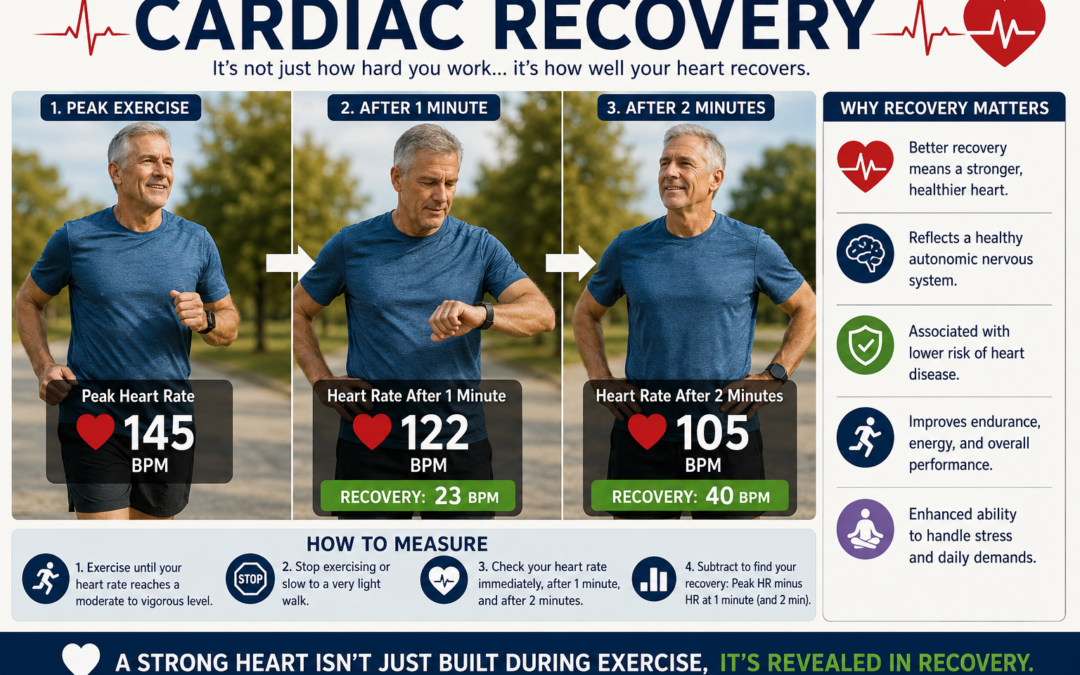
Cardiac Recovery: What It Is, How to Measure It, and Why It Matters
As a trainer who has spent years helping adults and seniors improve their health, I believe one of the most overlooked indicators of cardiovascular fitness is not how high your heart rate goes during exercise — it is how quickly your heart rate comes back down afterward. This is called cardiac recovery or heart rate recovery (HRR), and it can tell us a great deal about the health of your heart, nervous system, and overall conditioning.
For many people, especially adults over 55, understanding recovery can become a powerful tool in measuring progress and reducing cardiovascular risk. In my own journey training for quadruple bypass surgery, I learned that fitness is not only about how hard you can work — it is about how efficiently your body recovers afterward.
What Is Cardiac Recovery?
Cardiac recovery refers to how quickly your heart rate drops after exercise stops. During exercise your sympathetic nervous system — your “fight or flight” system — raises your heart rate so your body can deliver oxygen to working muscles. Once exercise ends, your parasympathetic nervous system — your “rest and recover” system — should quickly slow the heart back down.
A faster recovery generally indicates:
- Better cardiovascular conditioning
- More efficient autonomic nervous system function
- Improved aerobic fitness
- Better overall heart health
A slower recovery may indicate:
- Poor cardiovascular conditioning
- Elevated stress levels
- Fatigue or overtraining
- Increased cardiovascular risk
- Possible autonomic dysfunction
Research has shown that poor heart rate recovery is associated with a greater risk of heart disease and even mortality. That sounds frightening, but the encouraging news is that heart rate recovery can improve dramatically with consistent exercise.
How to Measure Heart Rate Recovery
Measuring recovery is simple and can be done during:
- Walking
- Treadmill exercise
- Stationary biking
- Elliptical workouts
- Rowing
- Outdoor cardio sessions
Step-by-Step Process
- Exercise until your heart rate reaches a moderate or vigorous level.
- Stop exercising completely or slow to a very light walk.
- Record your heart rate immediately at the end of exercise.
- Record it again after 1 minute.
- Record it again after 2 minutes.
The difference between your peak heart rate and the rate after one minute is your 1-minute heart rate recovery.
Example
- Peak heart rate: 145 bpm
- After 1 minute: 122 bpm
- Recovery score: 23 beats
That means your heart rate recovered by 23 beats in one minute.
What Is Considered Good Recovery?
In general:
| 1-Minute Recovery | Interpretation |
|---|---|
| 25+ beats | Excellent |
| 18–24 beats | Good |
| 12–17 beats | Fair |
| Less than 12 beats | Needs improvement |
A drop of fewer than 12 beats after one minute has been associated with increased cardiac risk in several studies.
Age-Related Heart Rate Recovery Guidelines
The following charts provide general guidelines for adults. These numbers are estimates and can vary based on medications, fitness level, hydration, stress, and medical conditions.
Ages 40–49
| Recovery After 1 Minute | Rating |
|---|---|
| 30+ bpm | Excellent |
| 22–29 bpm | Good |
| 15–21 bpm | Fair |
| Under 15 bpm | Poor |
Ages 50–59
| Recovery After 1 Minute | Rating |
|---|---|
| 26+ bpm | Excellent |
| 20–25 bpm | Good |
| 13–19 bpm | Fair |
| Under 13 bpm | Poor |
Ages 60–69
| Recovery After 1 Minute | Rating |
|---|---|
| 24+ bpm | Excellent |
| 18–23 bpm | Good |
| 12–17 bpm | Fair |
| Under 12 bpm | Poor |
Ages 70–79
| Recovery After 1 Minute | Rating |
|---|---|
| 20+ bpm | Excellent |
| 15–19 bpm | Good |
| 10–14 bpm | Fair |
| Under 10 bpm | Poor |
Why Recovery Matters So Much
1. It Reflects Your Real Fitness
Many people focus entirely on speed, weight lifted, or calories burned. But recovery reveals how efficiently the cardiovascular system functions. Two people may walk at the same speed, but the person whose heart rate drops faster afterward usually has better cardiovascular conditioning.
2. Recovery Reflects Nervous System Health
Heart recovery depends heavily on the parasympathetic nervous system. Chronic stress, poor sleep, anxiety, and overtraining can impair recovery even in people who exercise regularly.
This is why exercise should not merely exhaust you — it should strengthen your ability to recover.
3. Recovery Helps Prevent Overtraining
If your recovery numbers suddenly worsen, your body may be telling you:
- You need more rest
- You are dehydrated
- Your stress levels are elevated
- You may be getting sick
- Your workload is too intense
Your heart often speaks before your body breaks down.
4. Recovery Improves Longevity
Better cardiovascular recovery is strongly associated with:
- Lower blood pressure
- Better oxygen utilization
- Reduced cardiac strain
- Improved endurance
- Increased independence with aging
For seniors especially, this means more energy for daily life, better walking endurance, greater confidence, and improved overall resilience.
How to Improve Cardiac Recovery
The good news is that heart rate recovery improves surprisingly well with consistent training.
Walking
Never underestimate walking. Brisk walking performed consistently can significantly improve recovery numbers.
Zone 2 Training
Steady-state cardio performed at a moderate pace strengthens the aerobic system and improves parasympathetic recovery.
Interval Training
Short bursts of harder work followed by recovery periods can improve how efficiently the heart adapts.
Strength Training
Resistance training improves circulation, muscular endurance, and metabolic efficiency.
Sleep and Stress Management
Poor sleep and chronic stress can dramatically impair recovery.
Consistency
Recovery improves from regularity, not punishment. Small consistent efforts performed week after week usually outperform occasional extreme workouts.
A Final Thought
One of the beautiful things about exercise is that your body begins to adapt at almost any age. I have seen clients in their 60s, 70s, and even 80s improve their recovery numbers through walking programs, strength training, and consistent cardiovascular work.
Your recovery is your body’s way of telling you how resilient you are becoming.
Don’t become obsessed with intensity alone. Learn to respect recovery. A heart that recovers efficiently is often a heart that is growing stronger, healthier, and more prepared for the demands of life.
As I often tell my clients at Be Simply Fit, fitness is not just about surviving exercise — it is about recovering from life itself.