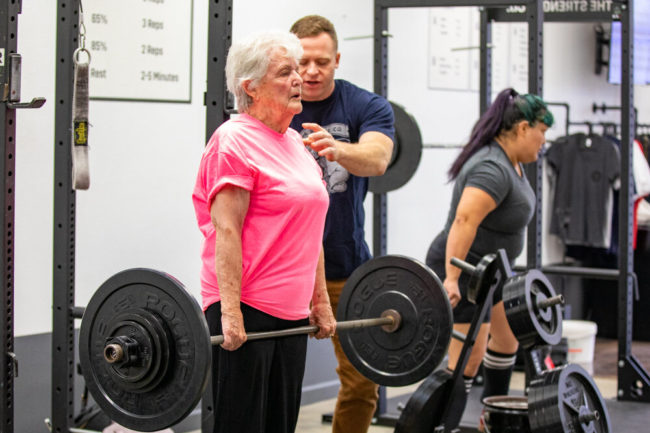
For years, older adults have been told to “take it easy.” Light weights. High reps. Gentle movements. While well-intentioned, that advice has quietly contributed to one of the biggest threats to healthy aging: loss of strength, loss of power, and loss of confidence in the body. Heavy resistance training—done safely, progressively, and with good coaching—is one of the most powerful tools older adults have to preserve independence, prevent falls, and stay upright for life. Let’s be clear about what heavy means. Heavy does not mean reckless. It means using enough resistance to challenge the muscles, bones, and nervous system in a meaningful way—usually weights that can be lifted for about 4–8 controlled repetitions with good form.
Why Strength Matters More After 50
Beginning in our 30s, we lose muscle mass every decade. After 60, that loss accelerates unless we actively fight it. This isn’t just about looking fit—it’s about survival skills.
Heavy resistance training:
- Preserves and rebuilds muscle mass
- Improves bone density
- Strengthens tendons and ligaments
- Improves joint stability
- Enhances nervous system response time
- Maintains the ability to get up, catch yourself, and stay upright
Light weights can maintain movement, but they rarely rebuild what aging takes away. Heavy resistance sends a clear message to the body: we still need strength.
Why Older Adults Shy Away from Heavy Weights
Most older adults don’t avoid heavy weights because they can’t do them—they avoid them because they’re afraid.
Common reasons include:
- Fear of injury
- Past pain experiences
- Lack of instruction
- Belief that heavy weights are “for young people”
- Gym intimidation
- Confusion between discomfort and danger
There’s also a cultural myth that aging bodies are fragile. In reality, bodies become fragile when they are under-loaded, not when they are trained properly. When heavy lifting is introduced gradually—with correct technique and recovery—it actually reduces injury risk by strengthening the structures that protect us.
Heavy Weights and Reactive Muscle Strength
Falls don’t happen slowly. They happen in milliseconds. Reactive muscles are the ones that fire instantly when you trip, slip, or lose balance. These muscles don’t respond well to slow, light training alone. They need load and intent.
Heavy resistance training improves:
- Rate of force development (how fast strength is produced)
- Neuromuscular coordination
- Reflexive muscle activation
- Confidence under load
When someone stumbles, the body must generate force quickly. A stronger nervous system and stronger muscles mean the difference between a recovery step and a fall.
How Heavy Training Prevents Falls
Falls are rarely caused by poor balance alone. They are caused by:
- Weak hips and legs
- Inability to decelerate the body
- Slow reaction time
- Lack of confidence during movement
Heavy resistance training targets all of these.
Squats, deadlifts, presses, rows, and carries:
- Train the legs to absorb force
- Teach the core to stabilize under load
- Strengthen grip and posture
- Reinforce movement patterns needed in daily life
This is not gym strength—it’s life strength.
Confidence Is the Hidden Benefit
One of the most overlooked benefits of heavy resistance training is psychological.
When older adults realize they can lift more than they thought possible:
- Fear decreases
- Movement becomes more natural
- Posture improves
- Hesitation disappears
Confidence changes how people walk, turn, climb stairs, and step off curbs. That alone reduces fall risk.
The Bottom Line
Heavy resistance training isn’t about ego. It’s about insurance.
It’s insurance against falls.
Insurance against frailty.
Insurance against dependence.
When done correctly, heavy resistance training doesn’t shorten life—it protects it. It teaches the body to respond, recover, and remain capable in a world that doesn’t slow down just because we get older.
The goal isn’t to lift heavy forever.
The goal is to stay strong enough to stay upright forever.
Jim Burns is a NASM Certified Personal Trainer, Senior Fitness Specialist, and a Corrective Exercise Specialist. He is accepting new clients and can be reached at besimplyfit23@gmail.com