
Why Understanding the Difference Matters — Especially If You’re on Heart Medication
As a trainer who has had a quadruple bypass and understands what it means to train with cardiac history, I have learned something very important:
How hard you feel you’re working and how hard your body is actually working are not always the same thing.
For anyone — but especially for those on heart medication like beta blockers — understanding this difference can make exercise safer, smarter, and more effective.
What Is Absolute Exertion?
Absolute exertion is the measurable, objective effort your body is producing.
It includes things like:
- Heart rate (beats per minute)
- Blood pressure
- Oxygen consumption (VO₂)
- Speed, pace, or resistance level
- Watt output on a bike
This is what machines and medical professionals measure.
For example:
- 140 beats per minute is absolute.
- Walking 4 mph is absolute.
- Lifting 100 pounds is absolute.
It doesn’t depend on how you feel — it’s what the data says.
What Is Rate of Perceived Exertion (RPE)?
Rate of Perceived Exertion (RPE) is subjective.
It’s how hard the exercise feels to you.
The most common scale is the Borg Scale (6–20), developed by Gunnar Borg, or the simpler 1–10 scale.
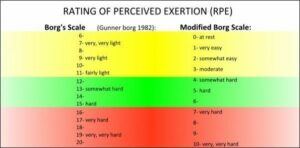
On a 1–10 scale:
- 1–2 = Very easy
- 3–4 = Light
- 5–6 = Moderate
- 7–8 = Hard
- 9–10 = Very hard / Max effort
RPE takes into account:
- Breathing rate
- Muscle fatigue
- Sweating
- Overall strain
- Mental effort
Two people walking side by side at the same speed may have very different RPE levels.
Why the Difference Matters
For healthy individuals not on medication, heart rate and RPE tend to correlate fairly well.
But when heart medications enter the picture, things change.
Heart Medications Change the Equation
Many cardiac patients are prescribed medications such as:
- Metoprolol (beta blocker)
- Valsartan (ARB)
- Other blood pressure or rhythm-controlling medications
Beta Blockers (like Metoprolol)
Beta blockers:
- Lower resting heart rate
- Blunt maximum heart rate
- Reduce heart contractility
- Limit adrenaline response
If someone uses a standard formula like:
220 – age = maximum heart rate
It will often be inaccurate if they are on a beta blocker.
For example:
A 70-year-old might calculate a max HR of 150 bpm.
But on metoprolol, they may never get above 110–115 bpm — even when working hard.
If that person trains strictly by heart rate zones, they may:
- Undershoot intensity (never challenge themselves)
- Or panic thinking they aren’t working hard enough
- Or worse, push beyond safe muscular fatigue trying to “chase” a number
ARBs (like Valsartan)
These may not blunt heart rate the same way, but they:
- Lower blood pressure
- Alter vascular resistance
- Can affect exercise tolerance
Again, numbers alone don’t tell the whole story.
When Absolute Exertion Becomes Misleading
Let’s say someone on metoprolol is exercising:
- Heart rate: 102 bpm
- Age-predicted target: 120 bpm
The data says: “Not working hard enough.”
But their:
- Breathing is labored
- Legs are fatigued
- RPE is 7/10
The body is saying: “This is hard.”
If we only look at absolute exertion, we miss the internal strain.
Why RPE Is Essential for Cardiac Clients
For individuals on heart medication:
RPE often becomes the more reliable tool.
Because:
- Medications alter heart rate response
- Stress and dehydration affect readings
- Fitness watches can be inaccurate
- Heart rate variability is blunted
RPE reflects:
- Muscle fatigue
- Breathing strain
- Neurological stress
- Overall systemic load
For most cardiac-history clients, moderate intensity should feel like:
- RPE 5–6/10
- Able to talk in short sentences
- Breathing deeper but controlled
- Challenging but sustainable
The Talk Test: A Simple Safety Tool
The “talk test” aligns closely with RPE.
- Can speak full sentences → Light to moderate
- Can speak short phrases → Moderate
- Can only say a few words → Vigorous
- Cannot speak → Very high intensity
For many cardiac clients, moderate effort is the sweet spot.
The Psychological Component
There is another layer.
Some individuals with heart history:
- Underestimate effort due to determination
- Overestimate effort due to fear
Understanding RPE helps reconnect mind and body.
You begin to trust:
- Your breathing
- Your fatigue
- Your warning signals
A Practical Framework for Clients on Heart Medication
If you are on medications like metoprolol:
- Do not rely solely on heart rate formulas.
- Use RPE as your primary guide.
- Combine RPE with the talk test.
- Warm up longer (10–15 minutes).
- Cool down gradually.
- Stop if you feel:
- Dizziness
- Chest discomfort
- Unusual shortness of breath
- Irregular heartbeat
Absolute Exertion Still Has Value
This doesn’t mean heart rate is useless.
Absolute metrics help:
- Track trends over time
- Identify abnormal responses
- Monitor recovery
- Communicate with physicians
But they must be interpreted in context. Especially when medication alters physiology.
My Personal Perspective
In my own journey, I learned something powerful: You cannot chase numbers blindly. You must learn your body. As I often say in my emotional fitness writing: “You can’t keep pulling up the flowers to see how the roots are doing.” The same applies to exercise. You cannot obsess over the heart rate monitor.
The real wisdom is understanding:
- How hard it feels
- How you recover
- How you respond the next day
Final Thought
For those on heart medication:
Absolute exertion tells you what the machine sees.
Rate of perceived exertion tells you what your body knows.
The safest and smartest training plan respects both. Exercise is medicine — but like all medicine, the dosage must be right. And when heart medication changes the numbers,
your perception may be the most honest guide you have.
Medical Disclaimer
The information provided in this article is for educational and informational purposes only and is not intended as medical advice. It is not a substitute for professional medical evaluation, diagnosis, or treatment. Exercise recommendations, including guidance on heart rate and rate of perceived exertion (RPE), may not be appropriate for everyone—especially individuals with cardiovascular disease, a history of cardiac surgery, arrhythmias, or those taking medications such as beta blockers or blood pressure medications. Always consult with your physician or qualified healthcare provider before beginning or modifying any exercise program. Never disregard professional medical advice or delay seeking it because of information you have read here.Participation in any exercise program is undertaken at your own risk. Be Simply Fit and its representatives are not responsible for any injuries, health complications, or adverse events that may result from the use or misuse of this information.